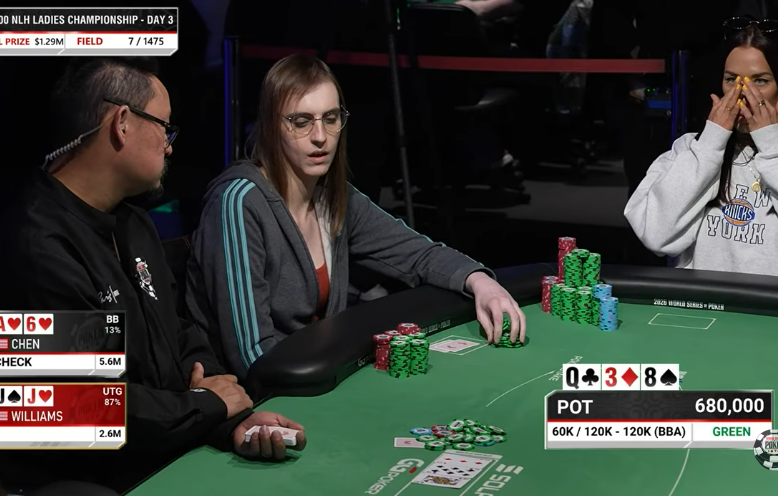
Aubrey Williams came within one cooler of a World Series of Poker bracelet on Sunday night. She didn't get it. What she got instead was $129,692, a two-hour heads-up fight that swung back and forth like a screen door, and a runner-up finish that turned into one of the most talked-about results of the entire series.
Williams, a 31-year-old transgender woman from Pennsylvania, finished second in Event #68, the $1,000 Ladies No-Limit Hold'em Championship, falling to amateur Skye Chen after a 1,475-entry field had been ground down to two. The headline-grabbing detail was her identity. The story that actually played out at the table was a grinder refusing to die.
Four big blinds, three double-ups, one short of the bracelet
By the time heads-up play started, Williams held a 5:3 chip lead and looked like the more seasoned player in the seat, which she was. Then Chen made the call of the tournament, correctly reading a Williams bluff and putting her stack on the line to snap it off. The double-up flipped the match. Williams was left with about four big blinds heading into a break.
That should have been the end. It wasn't. Williams doubled up three separate times to claw back into the match, the kind of short-stack survival run that usually only happens in someone else's bad-beat story. The chips finally went in for the last time with Chen holding pocket fours. Williams couldn't get there, the board bricked the ace she needed, and the fours held. Second place.
For context on who Williams actually is: this was not a fluke deep run by a recreational player. She's an accomplished tournament pro with close to $500,000 in live winnings on the Hendon Mob, and in January she took down the Borgata Winter Poker Open $1,000 Hybrid Championship in Atlantic City for $52,540. The $129K from this event is her biggest live cash to date.
"I'm a woman, so I play in the women's event"
Williams was clear that she wasn't there to make a point. She told PokerNews she entered simply because she's a woman playing a tournament, not because she was staking out any political position. She also doesn't do social media, which turned out to be a useful filter, given how the internet reacted. Williams said the internet is "not a real place."
Plenty of people online disagreed with her being in the field, some of it ugly. The response from inside the poker world was a lot less ambiguous. Caitlin Comeskey, who finished fourth in the same event, posted a blunt warning to anyone using Williams as engagement fuel, promising to come after rage-baiters "with the fire of 10,000 suns." Liv Boeree weighed in too, arguing that the point of ladies events is to offer a rare chance to play through a feminine lens and a social vibe regular tournaments don't have, and that Williams fit that vibe fine.
Why she was allowed to play, and why this isn't actually new
The eligibility question has a boring legal answer that predates this entire controversy. Nevada gaming law generally bars casinos from denying access based on sex, which is exactly why men have wandered into the Ladies Event over the years. Shaun Deeb famously did it in 2010, and the next year 15 men crashed the tournament, with one of them reaching the final table.
The WSOP's fix was financial, not exclusionary. In 2014 they introduced a "Ladies Night" discount: women paid the standard $1,000 buy-in while men were charged $10,000. Williams paid the $1,000 because her driver's license identifies her as female. No rule was bent. The structure that's been in place for over a decade simply applied.
The result
Skye Chen, an amateur and former software engineer playing her first WSOP event, won the bracelet and $194,630. It's a genuinely great underdog story in its own right. But the deep run that dominated the conversation belonged to the player who came second, survived on fumes, and walked away one ace short.