
This page is for information and support. It carries no offers or advertising. If you need help right now, the free helplines are in the Where to get help section.
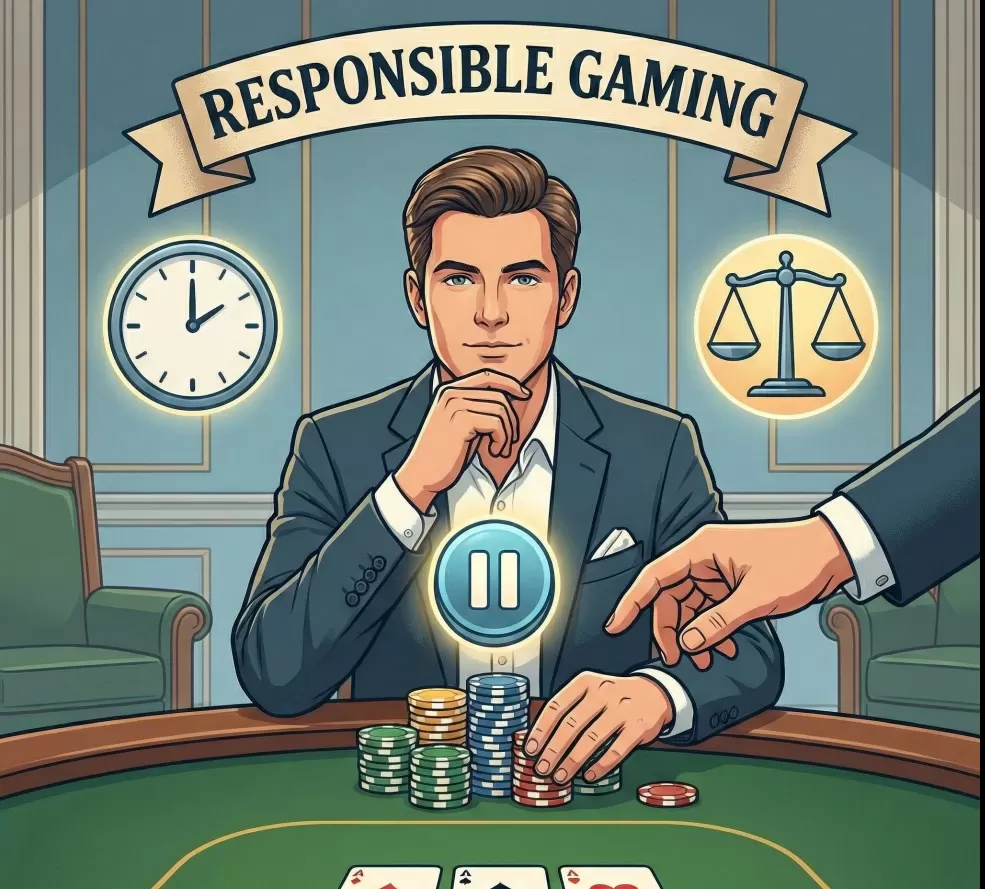
Poker is a game of skill, but every session is still gambling with real money. Decide your budget and your time before you sit down, use the limits every good poker room offers, and treat chasing losses, borrowing or hiding your play as signs to stop and talk to someone. Help is free, confidential and available around the clock.
Need to talk now? United States: call or text 1-800-MY-RESET. UK: 0808 8020 133 (National Gambling Helpline, GamCare). Anywhere: free online chat at gamblingtherapy.org.
We write about poker because we love the game: the decisions, the reads, the long grind of getting better. That only works when the game stays a game. This page explains how to keep it that way, how to spot when it is slipping, what tools you can switch on today, and where to get free, confidential help for yourself or someone close to you.
Warning signs to take seriously
Problem gambling is not about how much you win or lose. It is about what the game is doing to the rest of your life. If any of these sound familiar, it is worth pausing.
Chasing losses
Moving up in stakes or playing longer to win back what you lost, instead of ending the session.
Money meant for something else
Depositing rent, bill or savings money, borrowing, or selling things to keep playing.
Hiding it
Keeping deposits, losses or the hours you play from your partner, family or friends.
Losing track of time
Sessions that run far past what you planned, lost sleep, or play that pushes out work and family.
Playing to escape
Opening the poker client to get away from stress, boredom, loneliness or low mood.
Restless when you stop
Feeling irritable or anxious when you try to cut down, or trying to cut down and not managing it.
A private self-check
These nine questions follow the criteria clinicians use to recognise gambling disorder (DSM-5). Answer them honestly and privately; nobody sees your answers.
- Have you needed to play for bigger amounts to get the same excitement?
- Have you felt restless or irritable when trying to cut down or stop?
- Have you tried to control, cut back or stop, and not managed it?
- Do you often find yourself thinking about poker, planning the next session or how to get money to play?
- Do you play when you feel stressed, low, guilty or anxious?
- After losing, do you come back another day to get even?
- Have you lied to people close to you about how much you play or lose?
- Has gambling put a relationship, job or study at risk, or cost you one?
- Have you relied on others to bail you out of money problems caused by gambling?
What your answers mean: four or more "yes" answers in the same 12 months is the threshold clinicians use for gambling disorder, but even one or two are a reason to set firmer limits or talk to someone. This check is not a diagnosis; a helpline counsellor or your doctor can help you work out where you stand.
Risks that are specific to poker
Poker has traps that casino games do not, mostly because skill is real and makes it easy to believe that the next session will fix the last one.
Tilt
After a bad beat or a losing run, decisions get worse and stakes creep up. A loss limit that ends the session is the simplest cure.
"I'm a winning player"
Even strong players have losing months, and short samples are mostly luck. Results over a few thousand hands prove very little.
Rake and rewards
The room takes rake from every pot. Rakeback, VIP ladders and leaderboards reward volume; never play more hands just to reach a level.
Fast, easy deposits
Crypto and instant e-wallets make topping up take seconds. Deposit limits slow that down when you need it most.
Multi-tabling and long sessions
Several tables at once and late-night grinds make losses add up quickly and hide how long you have played.
Staking and borrowing
Borrowing from friends, staking deals or taking loans to play turns a game into debt. If you need to borrow to play, stop.
How to keep poker fun: seven habits
- Set a monthly poker budget from money left after bills and savings, and never top it up from anywhere else.
- Keep a bankroll that fits your stakes. A common rule is at least 20 to 30 buy-ins for cash games and far more for tournaments; if you cannot cover that, move down.
- Decide your stop points before you sit down: a loss limit (for example three buy-ins) and a time limit, with an alarm.
- Switch on the room's deposit limit on day one, while you are calm, not after a bad night.
- Do not play tired, drunk, angry or upset, and never to fix a money problem.
- Take a break every hour and step away from the screen after any big pot, won or lost.
- Track every session (date, hours, result) and withdraw part of your winnings instead of leaving everything in the account.
Tools you can switch on today
At the poker room
Licensed rooms must offer these. Many offshore and crypto rooms offer fewer, so if you cannot find a tool, ask live support to set it for you. Look under "Responsible Gaming", "Limits" or "My Account" in the cashier or client.
| Tool | What it does | When to use it |
|---|---|---|
| Deposit limit | Caps how much you can deposit per day, week or month. Lowering it works at once; raising it usually waits a cooling-off period. | From your first deposit. |
| Loss and wager limits | Stop play once you have lost or bet a set amount in a period. | If losses creep past your plan. |
| Session reminders | A pop-up showing how long you have played and what you have won or lost. | If sessions run long. |
| Time-out | Locks your account for a short break, from a day to a few weeks. | After a bad run or when life gets busy. |
| Self-exclusion | Closes your account, usually for six months or longer and sometimes permanently, and stops marketing. It cannot be undone early. | When you want to stop completely. |
Self-exclusion at one room does not close your accounts elsewhere. Exclude from every room you have played at, and add a blocker on your devices as well.
On your devices and with your bank
- Gambling blockers: Gamban and the free BetBlocker block gambling sites and apps on phones and computers.
- Bank gambling blocks: many banks and card issuers let you block gambling payments in their app or by phone.
- National self-exclusion schemes: some countries and US states run one scheme that covers every licensed operator at once (for example GAMSTOP for UK-licensed sites). Your local helpline can tell you what exists where you live.
Where to get help
Every service below is free and confidential. You do not need to be "bad enough" to call; talking early is easier than talking late.
| Service | Who it helps | How to reach it |
|---|---|---|
| National Problem Gambling Helpline (NCPG) | United States, 24/7 | Call or text 1-800-MY-RESET (1-800-697-3738), or chat at 1800myreset.org |
| National Gambling Helpline (GamCare) | UK, 24/7 | 0808 8020 133 or live chat at gamcare.org.uk |
| Gambling Therapy | Worldwide | Free online chat, forums and groups at gamblingtherapy.org |
| Gamblers Anonymous | Worldwide peer support | Meetings in person and online: gamblersanonymous.org |
| Gam-Anon | Family and friends of someone who gambles | gam-anon.org |
| Responsible Gambling Council | Canada (help lines differ by province) | responsiblegambling.org lists the help line for where you live |
Outside these countries, Gambling Therapy's chat is the quickest way to reach a trained adviser, and your doctor can refer you to local treatment. If you ever feel unsafe or think about harming yourself, call your local emergency number straight away.
If you are worried about someone else
- Pick a calm moment and talk about what you have noticed, not about who is to blame.
- Do not pay off gambling debts or lend money to cover losses; it usually keeps the problem going.
- Protect your own money: separate accounts and passwords are sensible, not hostile.
- Get support for yourself from Gam-Anon or a helpline; they help families as well as players.
Poker is for adults only
Real-money poker is for adults: 18 or over, and 21 or more in some countries and states. If children use your computer or phone, use parental controls such as Google Family Link or Apple Screen Time, or a gambling blocker, and never share your account or saved passwords.
What GlobalPokerSites does
Clear labels on every offer
Every room banner and bonus button on our site shows the minimum age, "T&Cs apply" and an "Ad" label, so it is always clear when something is advertising.
No offers on this page
Our help and legal pages carry no room promotions, and we do not market to anyone under 18.
Only where it is allowed
Rooms are hidden or greyed out for visitors from countries they do not accept, so we do not send players to rooms that will not take them.
Honest about the downsides
Our reviews explain how bonuses are really released, what the rake costs and which countries a room refuses, cons included.
If you see an ad on our site that you think breaks these rules, or you want a page removed from your view for responsible-gambling reasons, email legal@globalpokersites.com.
Last reviewed November 28, 2026 by the GlobalPokerSites editorial team (helpline numbers checked against each service's own information). This page is general information, not medical or financial advice.